


Reviews of Two Books Wrestling with Genomics
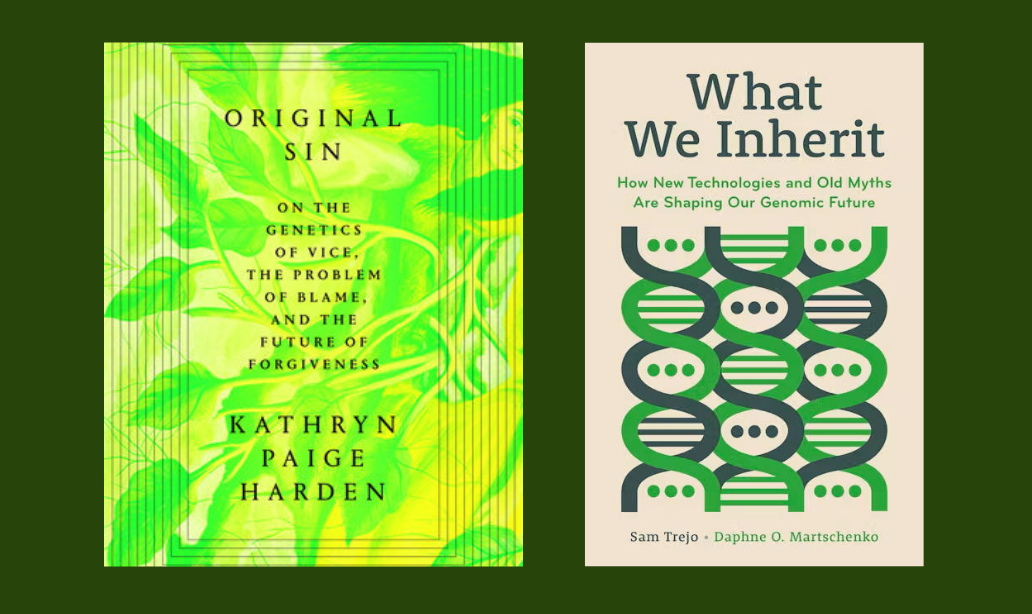
What We Inherit by Sam Trejo and Daphne O. Martschenko; and Original Sin by Kathryn Paige Harden have a great deal in common, with substantial differences in style and emphasis. Both books attempt, in different ways, to show the reader just where current research into human genomics stands, where that might be going, and why the authors are interested. In short, the influence of genomic research on our societies is already large and seems likely to change them in ways many of us find appalling.
What We Inherit
How New Technologies and Old Myths Are Shaping Our Genomic Future
by Sam Trejo and Daphne O. Martschenko
Hardcover $29.95, published February 3, 2026
Princeton University Press
What We Inherit starts with some basic history of modern genomics, which the authors built on what they call an “adversarial collaboration”: a quantitative sociologist (Trejo) arguing with qualitative bioethicist Martschenko. They met at Stanford, where Trejo earned his PhD and a pair of MAs; he now co-leads the Princeton Biosociology Lab. Martschenko is an Assistant Professor of bioethics at Stanford. In the book’s Preface, she explains that she had figured that she would be the critic of new genetic technologies and he would be the enthusiast. Not so. By the end, they were both curious about the risks and benefits of DNA research and applications.
They open the book with “Myths and Molecules,” which unpacks genetic determinism and the histories of racial categories, making the argument for careful attention to existing social inequalities as genomic data becomes more significant in our society. They do not shy away from the personal. Daphne’s father is White; her mother is Black. On that, most people agree. But their daughter is neither or both, at various times. Her mother accompanied her to primary school, which is presumably why she was assigned to a remedial reading class she did not need. Her father stormed into the school and demanded answers; he got them, Daphne changed classes.
Fast forward to Daphne’s 22-page Curriculum Vitae. By the way, Trejo’s CV is just as impressive. Sam has described himself as a quantitative social scientist who uses quasi-experimental and biosocial methods to study the reciprocal relationship between education and health.
Part II, Debates and Disagreements, opens with the first of the authors’ printed conversations, about “The Effects of Genetic Myths,” which recounts the many harms inspired by beliefs in genetic and racial differences. Daphne seems to have the deeper understanding, but essentially they agree with each other and so do I. In the chapter itself, Carrie Buck is primary but by no means the only focus:
In fact, as late as the 1930s, the Miss America beauty pageant required contestants to formally provide ancestry information for review, showing that they were members of “the White race.”
The rest of the chapter brings this sorry tale almost up to date, with the 2022 Buffalo shooter. Chapter 5 focuses on “The Effects of Genomic Research” and Chapter 6 is on “DNA and Social Inequality” and on these the authors are not always in agreement. Daphne gets the last word:
Was leaning into the complexity uncomfortable? Yes. Was it ultimately worth it? For sure.
Part III is Looking Forward:
Chapter 7, Polygenic Prediction at the Fertility Clinic
Chapter 8, Polygenic Prediction in the Hands of Consumers and Institutions
Chapter 9, The Future
By the end of the book, Daphne realized they had developed “a framework for how polygenic scores might be used to help people without exacerbating structural inequalities.” Sam admitted, it seems reluctantly, to have become “a bit optimistic,” despite noting that, in genomics, “the questions and disputes are only going to become harder.”
Daphne: “Geez, we’ve really got our work cut out for us, don’t we?”
For an easy read, which it is, this book is a remarkably deep discussion of some of the most important arguments our society faces.
Original Sin
On the Genetics of Vice, the Problem of Blame, and the Future of Forgiveness
by Kathryn Paige Harden
Hardcover, $30, published March 3, 2026
Penguin Random House
After quotes from St Augustine and William Blake, Original Sin, by Kathryn Paige Harden, opens with “A prologue, in which I take a psychedelic drug and realize how easily the illusion of self can dissolve, even as the feeling of responsibility lingers.” Yes, Paige and her partner are off to take LSD in the West Texas desert. The whole book derives from acid insight. I remember it well: As a hippie in the early 70s, acid turned me away from law school before I even started, and I have never regretted that. But I am certainly surprised at her acknowledgement, even though she lives in Austin.
Harden came to the attention of a wide public with her previous book, The Genetic Lottery: Why DNA Matters for Social Equality. This was described by her publisher as “A provocative and timely case for how the science of genetics can help create a more just and equal society.” We perhaps reviewed her take on the subjects of her book rather than the book itself: “She comes across as gifted, sincere, and somewhat insensitive to the realities of life in modern America for many people.”
Original Sin is a better book than The Genetic Lottery, better thought, better written, but still capable of raising hackles. She is a lapsed Christian, and neatly sums up her professional position:
Research like mine links inherited DNA differences between people with their tendency to behave in ways that invite punishment. Such science disturbs, provokes, unsettles. It needles us into remembering that we are not just minds; we are also bodies. We are moral agents embedded in an animal biology. We are not just the product of nurture but have natures, too.
If you cut her, does she not bleed? Well, she and her book were ripped apart in a remarkably ungenerous review in LARB, in April, by Jonathan Basile:
The book reads like an Eat Pray Love of biotech grifting, designed to make her into a public figure based on her personal journey, now presented as the living impetus for her advocacy.
In turn, Mike Fortun, also in LARB, in July, took Basile to the woodshed:
My science-centric account here is like Basile’s in one respect: it does not do justice to the larger themes of blame, punishment, and forgiveness that most concern Harden in her book.
Harden is struggling with both the scientific challenges of defining the mechanisms by which genes combine to influence the person we become, and the socio-political implications that would follow if we could reliably intervene in that process. Sometimes, she hits the nail right on the head, as when writing about quitting the church:
“Choice” seems like the wrong word. Does a wind-up toy choose to wind all the way down? Does a runner in an ultramarathon choose to collapse? Sometimes you find yourself done.
That simple realization may have nudged Harden's work toward what she sees as a dispassionate and detached analysis of connections between genes and human actions.
What We Inherit provides additional – and necessary – nuance by emphasizing the stakes of Harden's analysis. Applying genomics research effectively and ethically will require humility, generosity, and sustained scrutiny of the societal implications of these advances.
Of these two books, written in different voices by people with different backgrounds and approaches, What We Inherit may model a way forward. In their final dialogue, Trejo and Martschenko emphasize the importance of building bridges across disciplinary differences, particularly as genomics research stakes claims to explaining and intervening in the social. (Notably, Paige Harden is specifically thanked in their Acknowledgments, with others, for providing “crucial guidance and support.”)
In any case, I prefer What We Inherit, if only because of the Elvis Costello line: “There’s no such thing as an original sin.”