


How a Deeply Inhumane World Makes Having Children Difficult
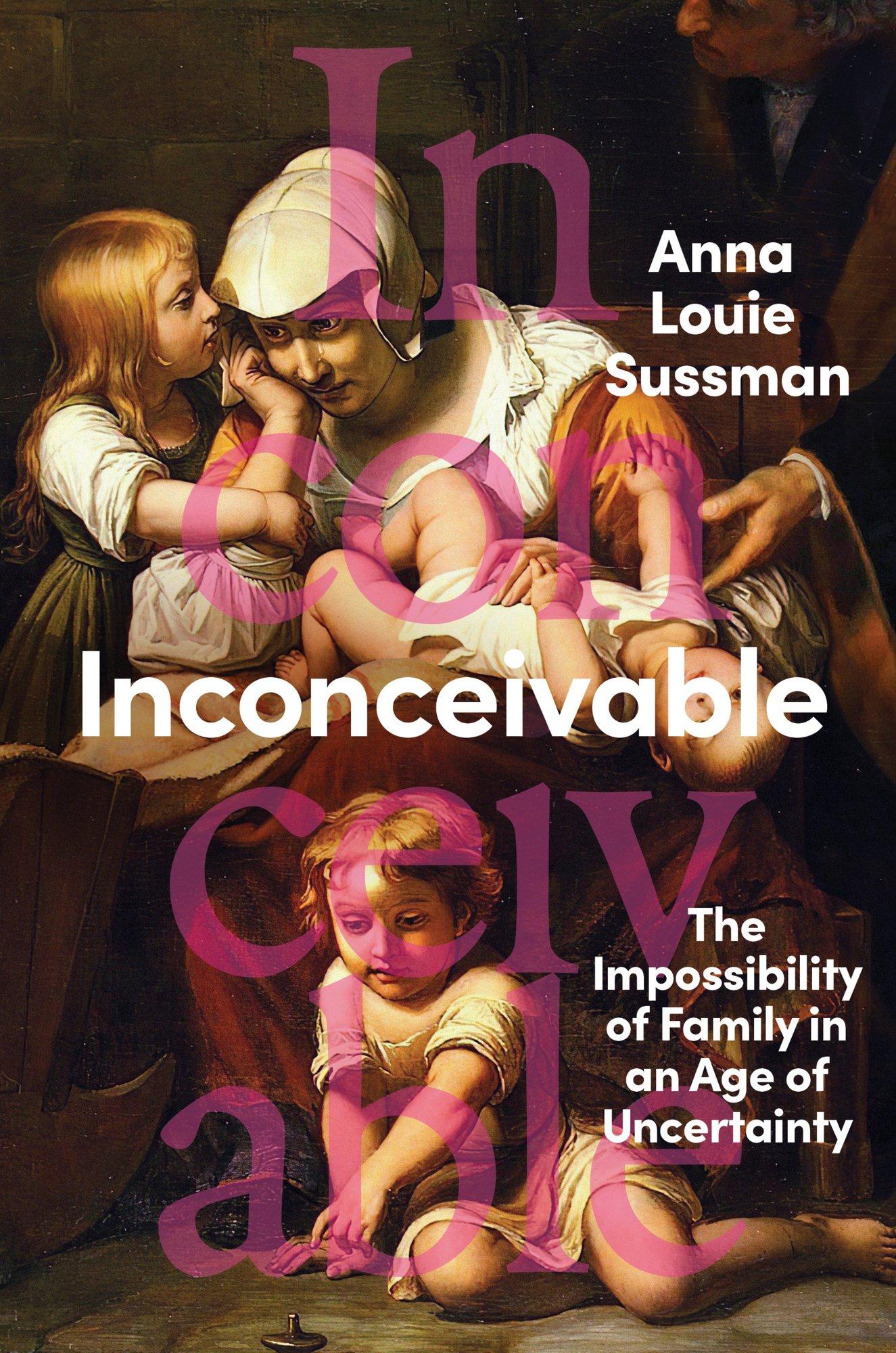
Almost every day I am reminded that we are in the midst of a fertility panic. Whether it’s the Vice President exhorting Americans to have more babies or The New York Times running yet another story about the fertility cliff, fear about falling fertility rates is everywhere. While centrally concerned with declining rates of childbearing, Anna Louie Sussman’s new book, Inconceivable: The Impossibility of Family in an Age of Uncertainty, is a welcome antidote to the panic.
Sussman has written a book that resists providing any easy explanation for slumping fertility rates. She places human vulnerabilities and stories at the center of her inquiry into why having children has become so difficult. In doing so, Inconceivable explores tensions and contradictions without trying to resolve them. Sussman resists denouncing any one way of approaching the decision to have children and instead emphasizes the structural forces that shape decision-making. Inconceivable ultimately argues that there is something deeply inhumane about a world that has made the fundamental human experience of procreation so difficult.
Sussman does not argue that fertility decline in and of itself is something about which we should panic. Instead, she offers a nuanced, narrative-driven account of the many interlocking aspects of the contemporary world that create obstacles to having children. Through a captivating combination of interviews with a range of people about their childbearing decisions and the synthesis of an impressive array of scholarly work, Sussman captures how fraught childbearing and childrearing have become across the globe, but particularly in the United States.
The book covers a lot of ground. From dating apps that make finding love feel transactional to the structure of paid work to the cost of childcare to environmental toxins that reduce fertility, Inconceivable explores the layered difficulties that people who want children often face in their efforts to procreate.
Readers of Inconceivable meet people from various walks of life who are grappling with similar dilemmas of how to make room for a baby amidst anxiety and an affordability crisis. These individuals are beset by outrageous student loans, housing precarity, demanding careers, and the prospect of unaffordable childcare. Although primarily focused on what it means to be or try to be a parent today, Inconceivable also attends in one chapter to those who choose not to be a parent. The inclusion of such accounts, from people who see their choice as an essential way of addressing environmental destruction and climate change, provided a welcome balance to the pronatalist frame that dominates most public discussions about declining fertility rates.
Sussman uses these stories to walk the reader through each individual’s dilemmas and decision making. She reveals the cost-benefit thinking that many people employ in deciding whether to have a baby, even as she suggests that having a child transcends this kind of straightforward economic thinking.
At one point, Sussman quotes reproductive justice scholar Loretta Ross who described her own connection to her newborn son as “primal,” saying that “there’s something about seeing yourself replicated in a human being that just takes away all your thinking brain. . . that mother bond is fucking real.” Inconceivable dwells in the space of this tension, between a “primal” desire for children and the reality of a capitalist system that is squeezing evermore people, forcing them to think in economic terms about procreation.
Another way that capitalism has perverted the domain of childbearing is through the proliferation of environmental toxins and their reproductive effects. Inconceivable details the many ways that our contemporary environment, especially endocrine disrupting chemicals, harms fertility and leads to more developmental issues in children. The book provides a moving account of the effect of environmental toxins on fertility and babies. The story of Alvarado, a farmworker in Salinas who had to work amidst pesticide sprays while pregnant and has twins with developmental disabilities stands out. Sussman’s account rightly highlights the role the environment can play in creating disability, thereby resisting the ubiquitous genetic prism that views disability primarily as a matter of genes.
Given these environmental barriers to childbearing, as well as the structural barriers Sussman discusses elsewhere, more and more people turn to the reproductive biotechnology industry to conceive. As Sussman puts it, because of the ubiquity of poisons in our environment, “human reproductive capacities now call out for repair.” The biotechnology industry presents itself as a solution to this problem, and in doing so generates enormous profits for itself. Inconceivable provides an account of the many problems with the fertility industry’s quest to get more people to make babies through IVF, including its high costs and focus on optimizing both the process of assisted reproduction and any resulting children.
One problem with the fertility industry is its tendency to overemphasize the importance of genes and genetic ties. Wary of how assisted reproduction’s promotion of both can “reinforce genetic relatedness or reinscribe the nuclear family,” Sussman nevertheless provides a sympathetic, personal account of seeking a child who shares her genes. Not willing to fully embrace or disavow the desire for genetic relatedness, Sussman again dwells in the tension, illuminating its complexity in the process. In fact, Sussman is grateful to fertility technology for the chance that it gave her to have her own baby. Her quest to become a mother is woven throughout the book. Eventually, using an egg she had frozen in Italy, Sussman welcomes the birth of her daughter.
As I was reading Inconceivable, the phrase “landscape of fear” repeatedly came to mind. This ecological concept describes how animals change their behavior based upon the presence of predators and their perception of risk. Sussman provides a compelling account of how the inequality and precarity engendered by capitalism provoke fear and anxiety in individuals contemplating childbearing and therefore shape what they choose to do. Although Sussman uses the ubiquitous term “uncertainty,” many people are downright scared about what the future holds in the face of environmental degradation and the ravages of capitalism. I wondered if stronger language could better capture these feelings. Having a child in such circumstances requires a leap of faith, a stubborn belief that human life can continue to flourish.
In the book’s conclusion, Sussman points to her reliance on an extensive kin network to raise her child as a source of hope that community and kinship beyond genetic ties can combat pervasive anxiety about the future and provide the grounds for human flourishing. It is on that hopeful note that the book ends, suggesting a way forward by leaning into and celebrating our interdependence outside of market relations. Can we imagine a world otherwise, and what would it look like to build a world in which the basic human experience of family creation is less difficult than our society has made it? Sussman’s book is a valuable contribution, helping us to imagine and therefore move closer to creating a world focused more on love than fear.
Jennifer Denbow is Professor of Political Science at Cal Poly, San Luis Obispo and a scholar of reproductive politics and technology. She is the author of Reproductive Labor and Innovation: Against the Tech Fix in an Era of Hype (Duke UP, 2024).