


Can You Really See Everything? Hype and Fraud in Silicon Valley
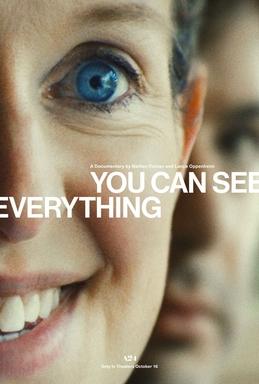
At the beginning of Nathan Fielder and Lance Oppenheim’s blockbuster documentary You Can See Everything, Billy Evans (partner of Theranos founder and convicted fraudster Elizabeth Holmes), says that they decided to do the film for one purpose: “radical transparency.” As they work on “Theranos 2.0,” Evans and Holmes want to show the public that she has been misunderstood –– painted as a liar and a fraud in the public imagination (and the courts) despite, as she claims in the documentary, having never told a lie or committed any crime. But as Fielder points out early on, there is overwhelming evidence that confirms that Holmes acted fraudulently and lies regularly.
The contradiction goes to the tension at the heart of this documentary: What does the promise of “radical transparency” really get you if it comes from someone known for its opposite? It’s a question with deep relevance not just for Holmes, but for Silicon Valley and the biotech industry writ large, where “science by press release” and closely guarded trade secrets sit side by side, and where big promises about speculative technologies blur the line between hype and fraud.
Fielder’s chosen title plays on this promise of transparency, not only from Holmes but from the genre of documentary film. Even if Holmes is a reliable liar, surely Fielder can be counted on to pursue, document, and present a truthful account. Yet Fielder himself becomes a main character in the documentary, lurking in the background of everyday activities in Holmes and Evans’ rented beachfront house, while the start of her prison sentence inches closer. Holmes reiterates here that nothing is held back from him; Fielder can see everything. The audience, in turn, sees Fielder seeing “everything” – often in incredible detail thanks to co-director Lance Oppenheim’s camera work.
Of course, crucially, what the audience really sees is a careful curation of scenes chosen by Fielder and Oppenheim, which shape the portrayal not only of Holmes and Evans, but also of Fielder (and eventually of a surprise guest). Including Fielder as a character in the documentary, along with elaborate simulations in the latter part of the film reminiscent of his previous project The Rehearsal, makes it clear how the manipulation of “transparency” is not limited to Holmes. Fielder is also creating a narrative in which certain things can be seen more easily than others, although hopefully without the nefarious motivations that characterize Holmes and Evans’ supposed transparency.
It all comes down to “can”
In a sense, Fielder deflates Holmes and Evans’ attempt to use the genre to their advantage, not by claiming that Fielder is the truthful alternative to Holmes and Evans, but instead by questioning the assumption about documentaries that Holmes and Evans’ scheme rests on. Fielder makes it obvious that documentaries carry their own narrative –– not objective truth. In doing so, he reminds the viewer that whatever Holmes and Evans want Fielder to show is decidedly not "everything."
This becomes especially clear in a memorable scene early on, when Holmes and Fielder look at components of a Theranos device. They discuss what Holmes meant when she claimed that “the device can run any test.” Holmes gives a convoluted explanation of what she meant by the statement: the device’s connection to the cloud meant that, as a platform, it could run any test it was instructed to –– assuming that the chemistry needed to run the specific miniaturized blood test had been invented and tested already (which was not the case for almost any test).
Fielder appears to give Holmes more benefit of the doubt than anyone familiar with the Theranos case –– and with Holmes’ track record of wide-eyed lying –– would. He concludes that it all comes down to the word “can” and how far you’re willing to stretch its conventional meeting. The device can run any test… if conditions incredibly far off from the reality we live in are met. While this scene makes the Fielder in the film look vulnerable to Holmes’ manipulations, its inclusion by Fielder himself clues the viewer in to his intentions as a filmmaker. He underscores the ambiguity of the title and the hollowness of Evans’ promise of “radical transparency”: “you can see everything,” taken in the way Holmes claims to have meant “can,” may actually mean the opposite.
The rest of the film further dismantles any semblance of “transparency”: Evans’ financial interest in the documentary becomes clear, and his impersonations of Holmes on the internet (with the help of X and AI tools) shifts Holmes’ public persona toward his own aggressive instincts. Because Fielder undermines the credibility of the documentary genre, though, it’s impossible to leave the film with the usual satisfaction that a fraudster’s scheming has been laid bare.
Rather than showing himself taking Holmes down thanks to an investigative journalist’s dogged pursuit of truth, Fielder gives the audience a shot of him looking downtrodden as he exits the jail where he visited Holmes. He cares about Holmes, and perhaps he even worries about Evans’ domineering behavior, Holmes’ separation from her children and her history of surviving sexual violence, even as he seems convinced that she has committed fraud. In the film’s final scene, Fielder conveys an uncertainty about the project and how he has chosen to make it, which again returns to the elusiveness of transparency.
Beyond Theranos: Trust, Distortion, and Hype in Silicon Valley
Theranos whistleblower Tyler Shultz’s widely shared review of You Can See Everything questions Fielder’s approach. Shultz thinks that by choosing to focus on ambiguities in Holmes’ claims, rather than the many examples of Holmes’ more evident lies, Fielder paints too sympathetic of a picture –– either for the sake of a more interesting movie or because Holmes manipulated him. Fielder, to my mind, is doing that on purpose. The whole point seems to be the ambiguity, the mixed motives, and the uncertainty. As he points out early in the film, why trust him –– a comedian and filmmaker –– to evaluate the scientific errors of Elizabeth Holmes?
Does Fielder mean to suggest he’s as unreliable as Holmes? I don’t think so. Fielder’s humility, and his invitation to the audience to question his own reliability, offer a stark contrast to Holmes’ grandiose claims that she has never lied (to which Fielder replies, because how could you not, “Liz, WHAT?”). Choosing to portray himself as uncertain and potentially unreliable encourages the audience to leave their desire for a neat narrative unfulfilled, and to reckon with the hubris of the belief that one can “see everything.”
Does that mean that Fielder is saying “trust no one” or implying that there is no such thing as the truth? I don’t think that’s exactly right. The film, and the immense response to it, demonstrates how the process of examining claims and deciding who to trust is a social one. Fielder shows himself poring over scripts with Amanda Seyfried (who portrayed a fictionalized Elizabeth Holmes in The Dropout), dissecting interactions, and discussing their perceptions –– and now moviegoers are doing the same in conversations with friends and in published reviews. Acknowledging how much we rely on one another to sort out who to trust, and on what grounds, underlines the need for more public scrutiny, more public discourse, and a clearer commitment to shared values. This is what will allow us to respond to the distortions of the tech industry today.
The propensity to confidently assert wild, false claims is not unique to Holmes –– in Silicon Valley startups, it’s practically a job requirement. Elon Musk is promising flying cars; Sam Altman of Open AI is predicting that AI will usher in “the singularity,” while Anthropic’s Dario Amodei thinks AI just might kill everyone; and Cathy Tie is insisting that her heritable genome editing startup “changes the entire paradigm of medicine as we know it.” Toothless appeals to transparency and oversight ring hollow when they are voiced alongside these absurdities. In Tie’s case, the lack of transparency is obvious –– no information is disclosed about her startup’s investors, techniques, or targets. And what would oversight mean for an endeavor that is already prohibited by policies in 70+ countries? Similarly, the information that AI companies share in the name of “transparency” just so happens to improve their stock options, while the forms of regulation and oversight they propose would likely cement their hold on the industry by blocking smaller competitors.
You Can See Everything reminds audiences of the importance and the difficulty of seeing through Silicon Valley inventors and investors’ hype and hollow appeals to crucial values. Scrutinizing the implications of the future that tech startup CEOs envision and attempt to create –– whether it’s a supposed “utopia” with eugenic underpinnings or a transhumanist doomsday scenario –– is a difficult task. As these companies try to win over the public, we'll need collective conversation and action to make progress toward real transparency and oversight.