Pronatalism Isn’t a Solution, It’s a Problem.
By Sarah Jones,
Intelligencer
| 04. 17. 2025
We don’t need more Elon Musk babies. We need reproductive justice.
From the Natalism website
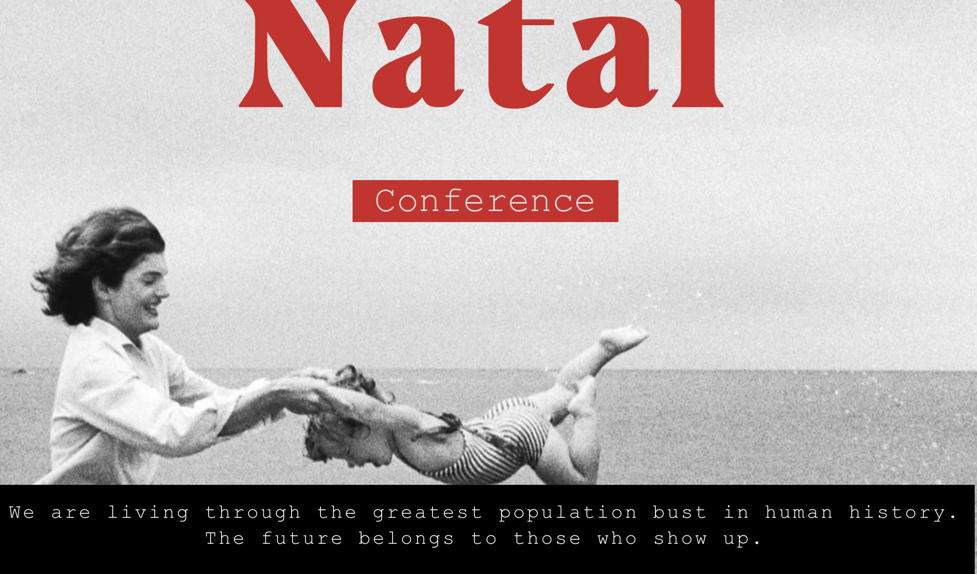
Elon Musk may not have appeared at the Natal Conference in Austin, Texas, this year, but he didn’t have to. The very concept of pronatalism owes its current prominence to him and his obsession with fertility. He wants to father a baby “legion,” The Wall Street Journal reported on Tuesday, which must increase “before the apocalypse.” He controls the mothers of his children through payouts and legal threats, he has reportedly told people that he is “concerned” that developing countries will outbreed the West, and he isn’t alone.
Former venture capitalist Simone Collins did attend NatalCon, where she told an NPR reporter that she was prepared to die in childbirth. She also said she “would rather not do that,” but explained that “historically, women died in childbirth at roughly similar rates to the rates at which men died protecting their land or country.” I have no idea if that’s true, and I doubt Collins does either. It’s the sort of nonsense a person says to provoke a reporter, and Collins is good at that. She...
Related Articles
By Gaia Ghirardi, Arno Van Hootegem & K. Paige Harden , Nature Human Behaviour | 09.21.2026
Embryo screening for behavioural traits is no longer speculative. If you want to become a parent in the USA today, you can pay to use pre-implantation polygenic testing (PGT-P) of in vitro fertilization (IVF)-created embryos. PGT-P promises to optimize offspring...
By Ann E. Marimow and J. David Goodman, The New York Times | 09.22.2026
Justice Elena Kagan on Tuesday refused to intervene in a high-profile custody battle that involved difficult questions surrounding surrogacy and abortion, leaving in place a lower-court order that gave custody to the biological parents in the dispute.
The case drew...
By Gay Pasley, Essence | 09.04.2026
That is what makes the unfolding case of McKenna West so important. It is more than a disagreement about abortion or a dispute over a surrogacy contract. It asks whether an agreement signed before a pregnancy can become authority...
By Ava Kofman, The New Yorker | 09.15.2026
A WOMAN WHO ACTS AS A SURROGATE, carrying a child for someone else, is said to be going on a “journey.”
Kayla Elliott started her surrogacy journey at the age of twenty-six. She gave birth to a baby girl for...