
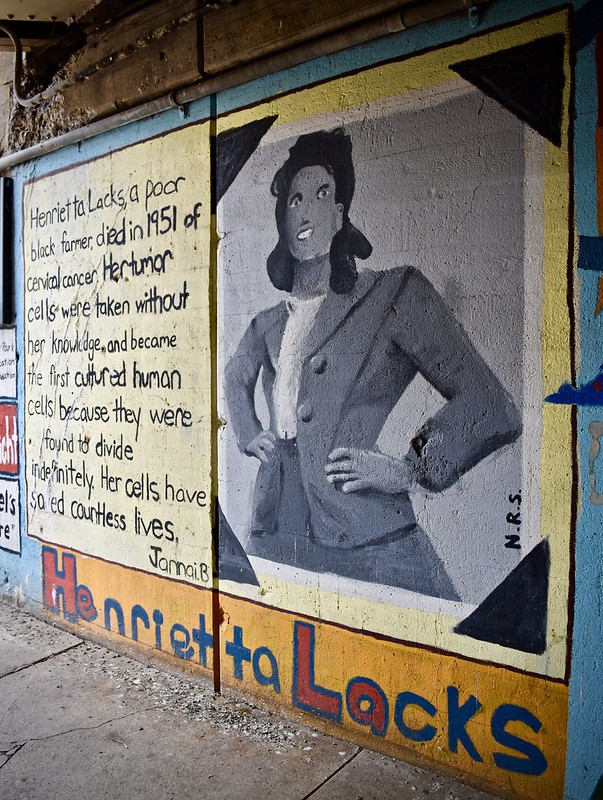
WHO honors Henrietta Lacks, woman whose cells served science
By Jamey Keaten,
Associated Press
| 10. 13. 2021
"Henrietta Lacks" by Crawford Brian is licensed under CC BY-SA 2.0
The chief of the World Health Organization on Wednesday honored the late Henrietta Lacks, an American woman whose cancer cells were taken without her knowledge during the 1950s and ended up providing the foundation for vast scientific breakthroughs, including research about the coronavirus.
The recognition from WHO Director-General Tedros Adhanom Ghebreyesus came more than a decade after the publication of “The Immortal Life of Henrietta Lacks,” Rebecca Skloot’s book about the discrimination in health care Black Americans faced, the life-saving innovations made possible by Lacks’ cells and her family’s legal fight over their unauthorized use.
“What happened to Henrietta was wrong,” Tedros said during a special ceremony at WHO Geneva headquarters before handing the Director-General’s Award for Henrietta Lacks to her 87-year-old son Lawrence Lacks as several of her other descendants looked on.
Lacks died of cervical cancer on Oct. 4, 1951 at age 31. The tissue taken from her at Johns Hopkins Hospital in Baltimore provided the first human cells to be successfully cloned. Reproduced infinitely ever since...
Related Articles
Media coverage of recent developments in embryo gene editing might seem to suggest that gene-edited babies are close to becoming a reality. As tech billionaires eager to profit off of techno-eugenics invest in “designer baby” technologies, attempts to normalize heritable genome editing – which remains unsafe and raises significant ethical and societal concerns – are especially dangerous. It’s worth taking a closer look at these developments and what they mean, in a way that pushes back on narratives normalizing the...
By Roxanne Khamsi, The Atlantic | 07.07.2026
When Ludivine Verboogen and Romain Alderweireldt’s third child was born in Belgium in late 2015, they marveled at his long fingers. Perhaps one day he will be a famous pianist, they thought. But soon Ludivine grew worried that her son...
By Julia Métraux, Mother Jones [cites CGS' Katie Hasson] | 07.07.2026
During his 2015 State of the Union address, then-President Barack Obama announced what he promised would be an ambitious public health project. “Tonight, I’m launching a new Precision Medicine Initiative to bring us closer to curing diseases like cancer and diabetes...
By Carl Zimmer and Marco Hernandez , The New York Times | 07.01.2026
Scientists have long dreamed of discovering the alchemy by which chemicals can be turned into life. On Wednesday, a team at the University of Minnesota announced that it had taken a major step toward that vision.
Blending together dozens of...