


News
Justin Schleede reaches onto a black lab bench to pick up a tray of small plastic tubes.
"These are saliva...
"If proven to be safe, we believe preventive gene editing could be one of the most important health technologies of...
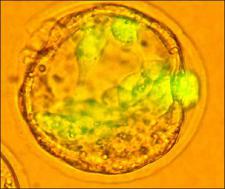
Recent developments in cell reprogramming methods should resolve debates about the use of human embryo embryos and women's eggs in stem cell research, but raise significant new ethical and social challenges, according to the Center for Genetics and Society, a public interest think tank.
"Scientists working with cell reprogramming are taking exciting steps toward medical treatments and advances in biological understanding," said Marcy Darnovsky, PhD, the Center's associate executive director. "But these techniques could also be misused for dangerous experiments in human reproduction. It's up to policy makers and the public to set rules against efforts to create cloned or genetically redesigned children."
The "induced pluripotent stem cells" (iPS cells) derived by cell reprogramming appear to have all the potential of embryonic stem cells but without controversial embryo destruction, and without the need for women to provide large numbers of eggs. Earlier this summer, UK scientists reported producing live mice from sperm derived from iPS cells, and primitive human sperm from embryonic stem cells. Last week, two separate groups in China announced that they had used iPS cells to create mice that were essentially cloned, as a demonstration of that iPS cells can differentiate into every tissue and cell type.
"The new set of challenges is very different, politically and ethically, from those raised by the past decade's stem cell debate," added Jesse Reynolds, the Center's policy director. "It's not about the status of human embryos; it's about the status of human beings. These issues include whether we want to give some people the ability to determine the traits of future generations."
Following last week's announcement of the mice created from iPS cells, stem cell scientists in the US and China said the new methods should not be used in human reproduction.
"There is wide agreement, among the public, scientists, and ethicists, in the US and elsewhere, that efforts to create cloned children and designer babies should be off limits," continued Darnovsky.
Forty-four countries already prohibit human inheritable genetic modification, and 58 prohibit human reproductive cloning. Of the 30 industrialized countries in the Organization for Economic Co-operation and Development, 26 have such laws. The United States has no national policy, although polls show that large majorities in the US oppose reproductive cloning and "designer babies."
"It is past time that the US join the international consensus and establish public oversight of genetic and assisted reproductive technologies, as well as of stem cell research," Reynolds said.
The Center is a non-profit public affairs and policy advocacy organization working to encourage responsible uses and effective societal governance of human genetic and reproductive biotechnologies. The Center operates BioPolicyWiki, a wiki-style compendium of country-level policies and binding international agreements governing reproductive and genetic technologies and practices.
Contact:
Marcy Darnovsky
1-510-625-0819 x305
mdarnovsky[AT]geneticsandsociety[DOT]org