


Good Trouble
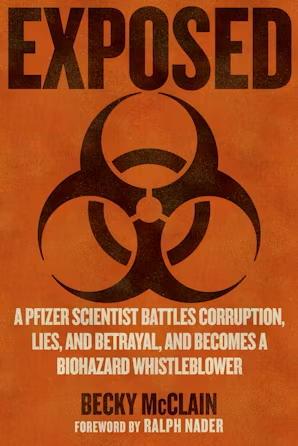
A Review of Exposed by Becky McClain
“Do not get lost in a sea of despair. Be hopeful, be optimistic. Our struggle is not the struggle of a day, a week, a month, or a year, it is the struggle of a lifetime. Never, ever be afraid to make some noise and get in good trouble, necessary trouble.”
— John Lewis
Becky McClain became famous when she successfully sued Pfizer, one of the very largest pharmaceutical and biotech companies. She was a molecular biologist with seventeen years of experience when she joined the company’s embryonic stem cell lab in 2000. But Exposed is not really a book about science, it is a book about our society, and human failures, and also, though less obviously, human determination and possibilities.
Exposed makes for an eye-opening and downright horrifying read. Almost everyone comes out badly — certainly Pfizer, the Occupational Safety and Health Administration, and most of the attorneys. But the reader comes away buoyed by McClain’s determination, intellectual force, and righteous anger. We need to mend our society, and we can.
McClain was excited to work on embryonic stem cell technology, but shocked by the condition of the Pfizer lab. For example, the place where she ate her lunch was right next to a freezer containing genetically modified embryonic stem cells and various potentially dangerous cultures. Other scientists shared her concerns but the working environment kept deteriorating. So did her status among management, as she spoke up in complaint. In return, she got terrible reviews that she convincingly writes she did not deserve. McClain came to think that her career was actually being sabotaged.
She became mysteriously ill in October 2003, with back pain, headaches, muscle spasms and drastic fatigue. This followed her being exposed to a lentivirus in the lab as a result of what we might politely call sloppy adherence to standard safety practices. She still suffers as a result of that exposure. Meanwhile, she had great difficulty working and found herself functionally unemployed and unpaid.
Eventually, she resorted to the courts for justice. Several attorneys refused to take her case (no money in it) and the first one who did wasn’t much help. In 2006, she signed a contract with Bruce Newman, Attorney at Law, to sue Pfizer. Because Pfizer argued that the list of pathogens McClain had been exposed to should be considered trade secrets, McClain was not able to prove that the company’s practices made her ill. In 2010, the jury ruled in her favor to the tune of $1.37 million in back pay and benefits for Pfizer’s retaliation after she spoke out about her concerns. Then it came out that the judge’s husband had retained the same law firm that was representing Pfizer; a new judge awarded McClain an additional $450,000 in legal fees and $460,000 in punitive damages, bringing the total to $2.3 million. In 2012 the Court of Appeals upheld the verdict.
McClain’s husband, a licensed pharmacist, had been working for the FDA, but seems to have fallen out of favor (likely because Pfizer said so) and eventually found a job with the Indian Health Service in New Mexico, where they now live.
The writing in Exposed is excellent, as is the Foreword by Ralph Nader; the Acknowledgments are generous and include CGS — McClain spoke at the 2011 Tarrytown Meeting, and the video is on her website.
What makes the book both valuable and terrifying are the details about people that McClain included. It is hardly a shock that a research lab for a huge company would contain some office politics, but many of these guys come off as jerks, not that she exactly says so. It is not too surprising that government officials might lean to supporting major corporations. Even some judges have been thought to overlook what mere laypeople might consider conflicts of interest.
McClain tells it as she saw it, and what she saw is outrageous, from rude individuals (most but not all male) to overbearing corporations. This book deserves a wide audience, and should provoke wide reforms, once the present administration fades into history. We must not forget.