


The Shameful Legacy of Tuskegee Is Still Relevant
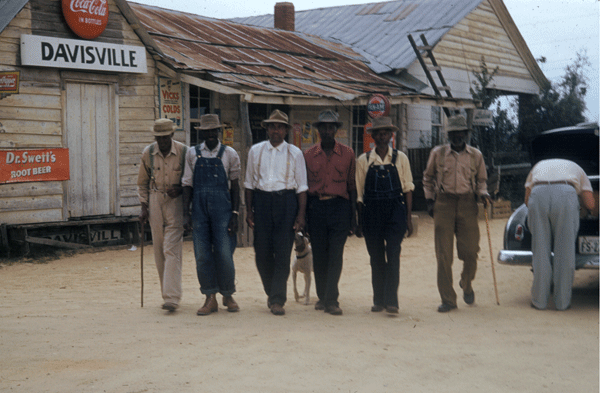
Group of Tuskegee Experiment test subjects
Public Domain via Wikimedia Commons
Every generation needs to learn about what is commonly known as the Tuskegee syphilis study, which ran from 1932 to 1972. (Officially, it was the U.S. Public Health Service Syphilis Study at Tuskegee, Alabama, which gets the emphasis right.) For many people, the history is hard to believe, though it is hardly unique. Of the 600 subjects, all Black men, 399 had syphilis, for which there was no cure available until the 1940s. Even then, the participants were not given the cure (penicillin), or told that there was a cure, or even that they had syphilis. They were studied, not treated.
By the time the study was halted, according to a 2022 Tulane University summary, "128 of the men died from the disease or its complications, 40 wives contracted the disease, and 19 children were born with congenital syphilis."
In 1997, President Clinton formally apologized in a White House ceremony attended by eight remaining survivors of Tuskegee. (The last, Ernest Hendon, died in 2004 at the age of 96.) At the White House ceremony, Herman Shaw, a survivor, still found it in his heart to say it was never too late to “restore faith and trust”:
“In order for America to reach its full potential,” Shaw said, “we must truly be one America — black, red, white together — trusting each other, caring for each other, and never allowing the kind of tragedy which has happened to us in the Tuskegee study to ever happen again.”
All these years later, history is repeating itself –– with, of course, some variations.
The latest scandal took almost a month to explode, and again involves the U.S. government, medical research, and Black people, this time in Africa not Alabama. The AP reported on December 19 that a $1.6 million no-bid contract had been awarded by the U.S. Centers for Disease Control and Prevention (CDC), to a group of Danish scientists to study the effects of hepatitis B vaccine in Guinea-Bissau, where the virus is endemic. CDC is part of the Department of Health and Human Services (HHS), which is currently headed by Robert F. Kennedy Jr., a notorious vaccine skeptic. Hepatitis B can be transmitted at birth, if the mother is infected, or contracted later. Its damaging health effects appear later in life in the form of liver damage and cancer.
The World Health Organization strongly recommends that all children receive a birth dose of hepatitis B vaccine, but Kennedy disagrees. The University of Southern Denmark’s Bandim Health Project, which has conducted vaccine research in Africa for many years, has a controversial reputation but has been praised by Kennedy. He expects half the children in this experiment to be vaccinated and the other half to be studied. AP quoted scientists comparing this to the infamous Tuskegee Study.
Thanks to several anonymous leakers from the U.S. Department of Health and Human Services (HHS), and a few alert commentators, this description has been catching on. Dr Paul Offit, a vaccine expert, headlined his January 6 Substack report “RFK Jr.’s Tuskegee Experiment.” Jeremy Faust, who runs the Substack Inside Medicine, also asserted in his headline “This is another Tuskegee.”
The Guinea-Bissau hepatitis B project is apparently still in process, according to the Washington Post, although there were reports that it had been cancelled on Thursday, January 15. This may indicate that there is some disagreement between the U.S. Department of Health and Human Services on the one hand and the Africa Centers for Disease Control and Prevention on the other. Jessica Malaty Rivera, a member of Defend Public Health, a group of public health researchers, health care workers and advocates, summed up the situation:
“No ethical board in the U.S. would ever approve of something like this. Of course they would go to a place where they can get away with it.”
The most recent reports suggest that Guinea-Bissau’s political instability and limited research review resources both played a role in a local ethics committee’s approval of the study late last year. Now, the Minister of Public Health –– who was just recently appointed to the role after a military coup in November led to leadership changes in the government — has said that the study is suspended, perhaps canceled, pending further ethical review with additional resources from Africa CDC.
The project itself is ethically appalling, not least because only half these infants would be given the Hepatitis B vaccine at birth (along with standard neonatal vaccines BCG [tuberculosis] and OPV [oral polio vaccine]). Almost one-fifth of the population of Guinea-Bissau, and presumably of the mothers involved, have Hepatitis B but do not know it. The mothers will therefore pass on the disease to their babies, who statistically are likely to have a shorter life than they otherwise would. For much more on this, see this article at Jeremy Faust’s Inside Medicine substack, which runs over more than 3,500 words and concludes by quoting a CDC official, anonymous for obvious reasons:
“This study needs to be stopped.”