Reparations for CA forced sterilization survivors: Support AB 1007
By Aminah Elster,
The Daily Californian
| 04. 02. 2021
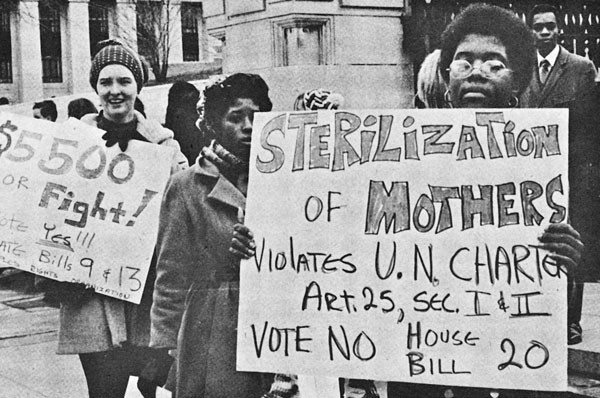
Between 1909 and 1979, California forcibly sterilized over 20,000 people of color, people with disabilities and imprisoned people. Based on white supremacist eugenics laws and ableist conceptions of who was “unfit to reproduce,” people with disabilities and women of color suffered forced sterilization. While the state’s eugenics laws were officially repealed in 1979, advocates working in California’s women’s prisons in the early 2000s uncovered continued coercive sterilizations occurring inside the prisons which targeted women and transgender and gender-nonconforming people of color.
For the third year in a row, the California Coalition for Women Prisoners is co-sponsoring legislation, AB 1007, introduced by Assemblywoman Wendy Carrilo, to provide compensation and reparations to survivors of forced sterilizations in the women’s prisons. The two other co-sponsors are California Latinas for Reproductive Justice and Disability Rights Education and Defense Fund. This important legislation has failed to win budgetary approval in the past. This year, we are hopeful that with increased public awareness and pressure, California will finally be held accountable for this horrific form of racist and gendered state violence.
A state audit conducted in...
Related Articles
Artificial Intelligence (AI) has been a major focus of news recently, as it should have been, under the appropriately ridiculous name of Hugging Face, “a leading collaboration platform and community hub for machine learning, artificial intelligence, and data science.” In July, Hugging Face was hacked. The platform itself responded:
Earlier this week, we detected and responded to an intrusion into part of our production infrastructure. This one was different from anything we had handled before in one important way...
By Gay Pasley, Essence | 09.04.2026
That is what makes the unfolding case of McKenna West so important. It is more than a disagreement about abortion or a dispute over a surrogacy contract. It asks whether an agreement signed before a pregnancy can become authority...
By Anna L. Philippe, Pop Panic | 09.17.2026
What does it mean when education is considered a threat to population? As an education student, I am interested in the ways population panics are essentialized and circulated in formal education settings. Schools can play a major role in shaping...
By Ava Kofman, The New Yorker | 09.15.2026
A WOMAN WHO ACTS AS A SURROGATE, carrying a child for someone else, is said to be going on a “journey.”
Kayla Elliott started her surrogacy journey at the age of twenty-six. She gave birth to a baby girl for...