


News
THE INSTAGRAM POST, precision-guided by sex and age, had zeroed in on its target. Yuchen Tu is a conservatory-trained viola...
This is the 16th installment in the Legacies of Eugenics series, which features essays by leading thinkers devoted to exploring...
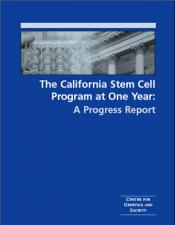
The Center for Genetics and Society releases progress report calling for effective oversight and responsible research
Oakland, CA - The Center for Genetics and Society (CGS), a public interest and advocacy group, today released a comprehensive progress report critically evaluating the first year of the California Institute for Regenerative Medicine (CIRM), the agency running California's new multi-billion dollar stem cell research program. The report assesses the CIRM's performance, assigns grades in key areas, and offers specific policy recommendations. The overall grade it assigns for the CIRM's first year is C-.
"A year after the creation of California's stem cell agency, its performance has been very disappointing," says Marcy Darnovsky, CGS Associate Executive Director. "If publicly funded stem cell research in California is going to move ahead in a responsible way, the CIRM will have to establish much stronger oversight and regulatory mechanisms. We hope that it will do so."
The report calls for action in three broad areas. First, the CIRM should fulfill its campaign promises, such as ensuring financial returns to the state. Second, the CIRM should move quickly to establish accountable and responsible governance. Towards this end, Robert Klein should step down as chair of the CIRM's governing board. Finally, the CIRM should adopt enforceable ethical safeguards and research standards, such as those that will protect women who may provide eggs for the research.
The ongoing stem cell and cloning research scandals involving South Korean and U.S. scientists have heightened many of the concerns of CGS and other public interest groups. "Stem cell researchers have generated inflated expectations and resisted responsible oversight," says CGS's Jesse Reynolds, the report's lead author. "We can't leave this important field to the scientists and biotech entrepreneurs now running the show."
"The California stem cell program and the recent scandals hold important lessons for legislators in other states and in Congress," continues Reynolds. "The combination of overheated promises, political polarization, and insufficient oversight makes this an especially critical time to examine this profound scientific and political endeavor."
CGS believes that the lessons learned from the California experience need to be taken to heart if research on stem cells and other emerging biotechnologies is to be pursued in a responsible and effective manner.
Read:
Contact:
Marcy Darnovsky
510-625-0819 x305
Parita Shah
510-625-0819 x312