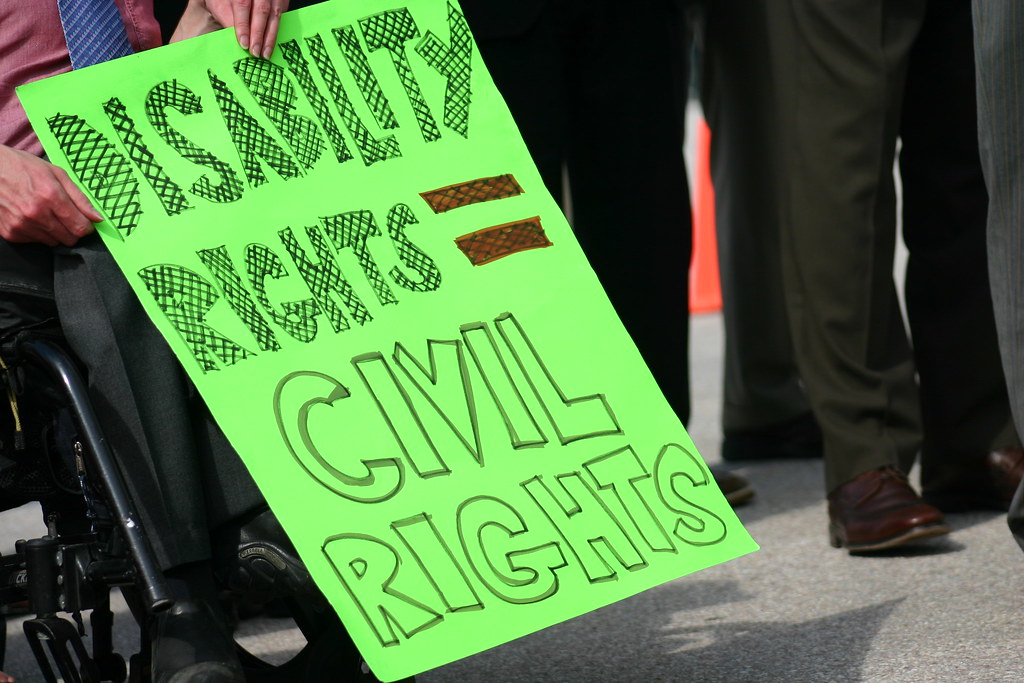
Supreme Court outlawed segregation of disabled people 25 years ago. But change has come slowly
By Timmy Broderick,
STAT
| 06. 21. 2024
Image by The Leadership Conference on Civil and Human Rights from Flickr
As a toddler, Veronica Ayala loved Fridays. At 5 o’clock sharp, her mom whisked her away from the grim Moody State School for Cerebral Palsied Children for a 48-hour reprieve. Ayala’s house was mere minutes away, but the doctors insisted that she had to live at the Galveston, Texas institution during the week so she could learn how to walk.
“It was supposed to be for six months. Then it was a year, and then it went into 18 months. I basically had achieved the goals I was there to achieve. They tried to keep me longer” but her mom removed her from Moody’s, said Ayala, who stayed there in the early 1970s and is now a disability rights advocate. “I didn’t even realize how traumatic it all was until years later when someone asked me about it, I just broke down in tears. I was a child, you know? I didn’t understand.”
Prolonged, involuntary stays in institutions used to be the norm for people with disabilities...
Related Articles
By Charles Schmidt, Undark | 09.25.2026
In 2010, scientists at the University of Tokyo and other institutions reported a startling achievement: They had successfully grown a pancreas made almost entirely of rat cells within the bodies of mice. The research was directed by Hiromitsu Nakauchi, a...
By Rob Stein, NPR [cites CGS' Katie Hasson] | 09.29.2026
Cathy Tie slips on a white lab coat bearing her name and the logo of her startup: Origin Genomics. "Welcome!" she says as she leads an NPR reporter, photographer and videographer on an exclusive tour of Origin's labs located...
By Erik Adams, Sundance | 09.08.2026
The scariest movie playing at the 2026 Sundance Film Festival isn’t about cursed audio recordings or a killer demon disguised as your true love; rather it’s a 110-minute essay film about how a handful of guys obsessed with numbers and...
Artificial Intelligence (AI) has been a major focus of news recently, as it should have been, under the appropriately ridiculous name of Hugging Face, “a leading collaboration platform and community hub for machine learning, artificial intelligence, and data science.” In July, Hugging Face was hacked. The platform itself responded:
Earlier this week, we detected and responded to an intrusion into part of our production infrastructure. This one was different from anything we had handled before in one important way...