
How Science has Shifted Our Sense of Identity
By Nathaniel Comfort,
Nature
| 10. 08. 2019
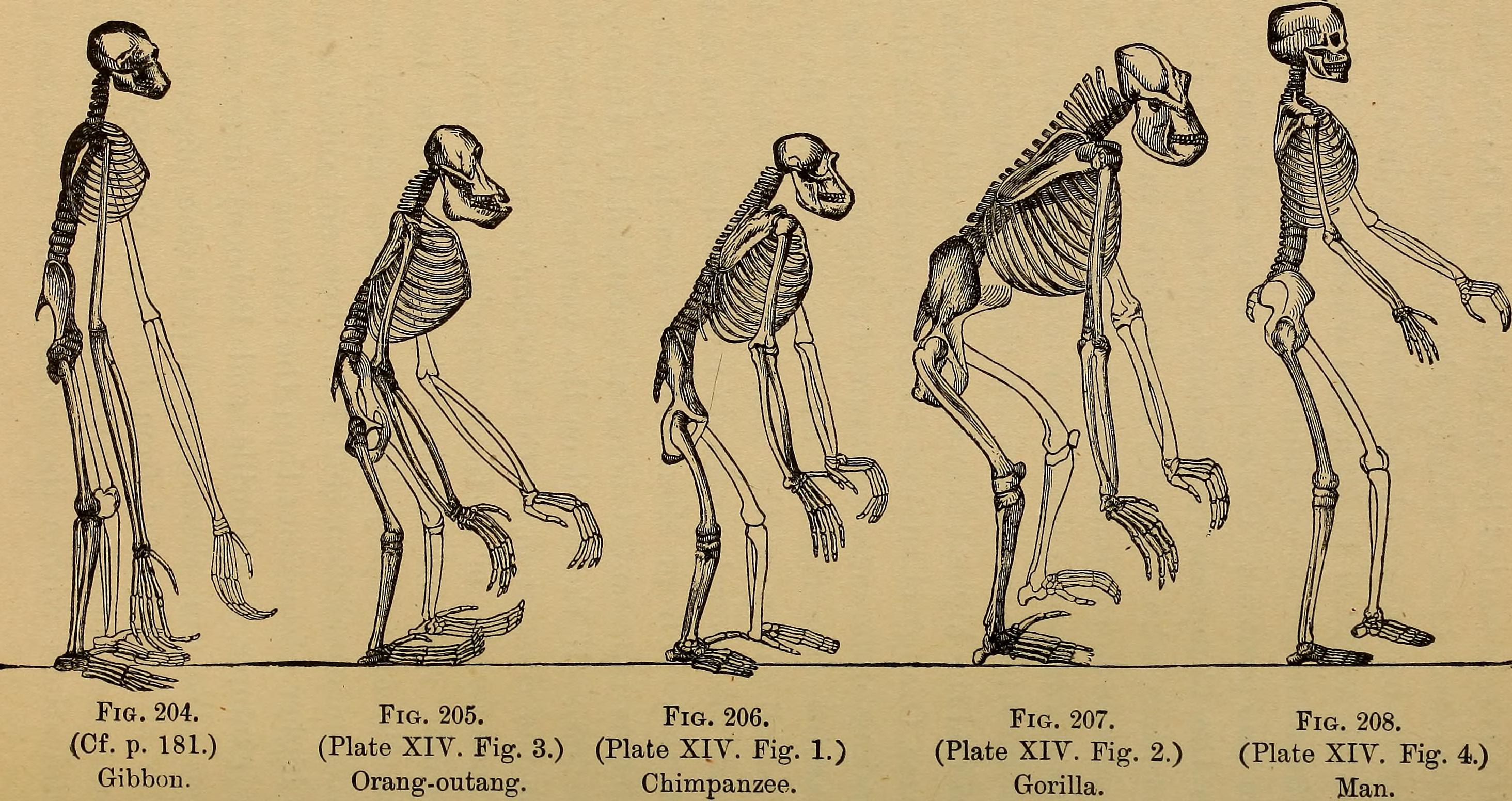
In the iconic frontispiece to Thomas Henry Huxley’s Evidence as to Man’s Place in Nature (1863), primate skeletons march across the page and, presumably, into the future: “Gibbon, Orang, Chimpanzee, Gorilla, Man.” Fresh evidence from anatomy and palaeontology had made humans’ place on the scala naturae scientifically irrefutable. We were unequivocally with the animals — albeit at the head of the line.
Nicolaus Copernicus had displaced us from the centre of the Universe; now Charles Darwin had displaced us from the centre of the living world. Regardless of how one took this demotion (Huxley wasn’t troubled; Darwin was), there was no doubting Huxley’s larger message: science alone can answer what he called the ‘question of questions’: “Man’s place in nature and his relations to the Universe of things.”
Huxley’s question had a prominent place in the early issues of Nature magazine. Witty and provocative, ‘Darwin’s bulldog’ was among the most in-demand essayists of the day. Norman Lockyer, the magazine’s founding editor, scored a coup when he persuaded his friend to become a regular contributor. And Huxley knew a soapbox when...
Related Articles
By Roxanne Khamsi, The Atlantic | 07.07.2026
When Ludivine Verboogen and Romain Alderweireldt’s third child was born in Belgium in late 2015, they marveled at his long fingers. Perhaps one day he will be a famous pianist, they thought. But soon Ludivine grew worried that her son...
By Julia Métraux, Mother Jones [cites CGS' Katie Hasson] | 07.07.2026
During his 2015 State of the Union address, then-President Barack Obama announced what he promised would be an ambitious public health project. “Tonight, I’m launching a new Precision Medicine Initiative to bring us closer to curing diseases like cancer and diabetes...
By Carl Zimmer and Marco Hernandez , The New York Times | 07.01.2026
Scientists have long dreamed of discovering the alchemy by which chemicals can be turned into life. On Wednesday, a team at the University of Minnesota announced that it had taken a major step toward that vision.
Blending together dozens of...
By Michael Le Page , New Scientist | 06.25.2026
We now know the master gene that controls embryonic development in people. Called NANOG, its role has been identified by making precise changes to the DNA of fertilised eggs using a technique called CRISPR base editing.
The discovery might lead...