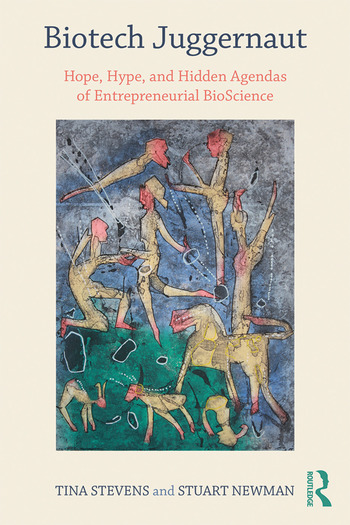
A Biotechnology Crossroads
By Becca Muir,
Science for the People
| 02. 01. 2021
Before Tina Stevens and Stuart Newman wrote Biotech Juggernaut, Newman helped Stevens fight legal action from an unexpectedly powerful adversary. Two scientists and the financer-author of Proposition 71, a 2004 California state initiative to fund stem cell medicine and promising imminent cures, wanted to prevent Stevens expressing her “false and misleading” views about the bill. Advocates said Proposition 71 would lead to miracle treatments for serious, debilitating illnesses such as Alzheimer’s, multiple sclerosis and heart disease. Using DNA from a patient and an egg donated by a healthy woman, researchers would produce embryonic stem cells that could then specialise and replace virtually any cell in the patient’s body.
But, Stevens, a bioethicist and historian, felt uneasy about the scientific and ethical claims of the proposition. She was part of a progressive wing of activists who were concerned about the serious risks posed to women who donated eggs for this research, as well as the troubling ethical implications of some of the techniques used. The type of stem cell research proposed in the proposition constituted a form of human cloning – somatic...
Related Articles
By Rob Stein, NPR [cites CGS' Katie Hasson] | 09.29.2026
Cathy Tie slips on a white lab coat bearing her name and the logo of her startup: Origin Genomics. "Welcome!" she says as she leads an NPR reporter, photographer and videographer on an exclusive tour of Origin's labs located...
Artificial Intelligence (AI) has been a major focus of news recently, as it should have been, under the appropriately ridiculous name of Hugging Face, “a leading collaboration platform and community hub for machine learning, artificial intelligence, and data science.” In July, Hugging Face was hacked. The platform itself responded:
Earlier this week, we detected and responded to an intrusion into part of our production infrastructure. This one was different from anything we had handled before in one important way...
By Miryam Naddaf, Nature | 09.21.2026
A wave of epigenetic therapies is offering hope as ways to cure chronic hepatitis B — a lingering liver infection that is caused by the hepatitis B virus (HBV) and affects more than 250 million people around the world. Currently...
By Karen Weintraub, Endpoints News | 09.16.2026
To better understand certain neuropsychiatric disorders, researchers at Stanford University have bred rodents that lack a cortex and hippocampus and then replaced those missing brain cells with human ones.
The altered mice, a scientific first, provided insights that would not...