


Book Review: How to Rule the World
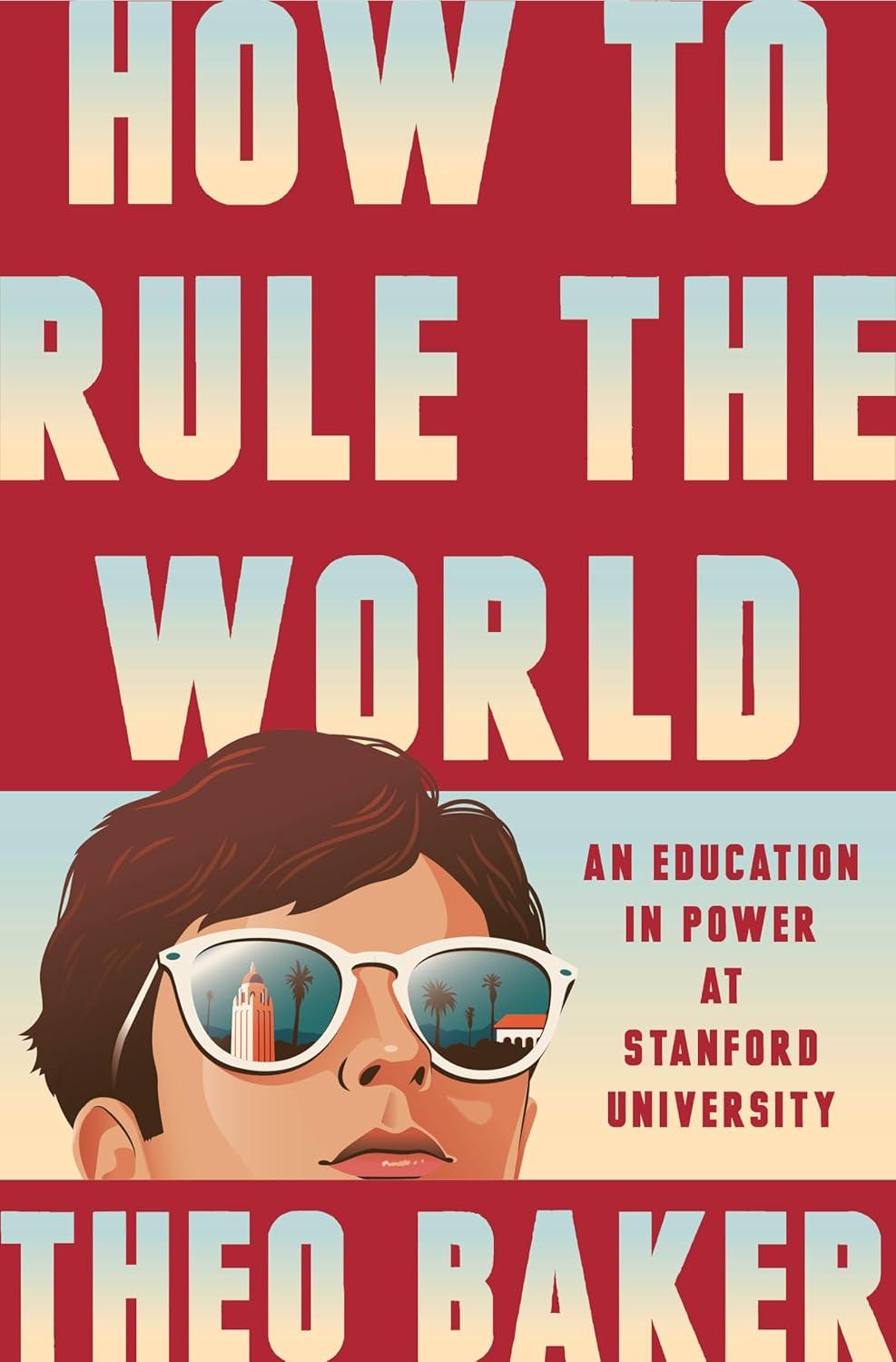
The title of this book is clever, not least because it is borrowed from a very secret society of a dozen Stanford students. Theo Baker, a gregarious computer science freshman, was interviewed by the hyper-rich anonymous entrepreneur who quietly assembled the members. The unspoken suggestion was that he might consider hiring some of the members in service of acquiring his next billion. (Either Baker was not offered a place or he is not admitting it.) Such are the ways of Stanford.
The sub-title is better yet. How to Rule the World is essentially the story of a very sharp freshman navigating Stanford in an era of AI hype and big tech money. In 2022, Baker entered the university as a 17-year-old junior coder [computer programmer] who wanted to meet people, have fun, and choose his future. Stanford’s billionaire alumni include Larry Page and Sergey Brin (Google); Phil Knight (Nike); Jensen Huang (Nvidia); Reed Hastings (Netflix). Who might be next? And along the way, who might get hired? Baker describes a campus awash in tech money or dreams of it, from the venture capitalists courting students who might build the next big thing to classmates dropping out to launch companies they hoped would become unicorns.
Both Baker’s parents are distinguished journalists, his mother at The New Yorker and his father at The New York Times, but Theo was a computer geek. He had no intention of following the family tradition but he slipped into it accidentally by noticing, enjoying, and ridiculing the “War on Fun” that had recently been waged by authorities who insisted that any social gathering had to be approved well in advance by the Party Review Committee. How could he resist writing about this for The Stanford Daily, the student newspaper?
On October 24, 2022, he published the somewhat less than earth-shattering:
Inside “Stanford’s War On Fun”:
Tensions mount over University’s handling of social life
That started his career. Journalists need tips to find stories, and Baker got what turned out to be a doozy. One of his readers shared a text chain with him, and suggested that a blog from a few years earlier might be worth investigating.
It was.
The chain included seven-year-old comments that pointed out “irregularities” in a paper published in Science of which Marc Tessier-Lavigne, then the president of Stanford, was one of two authors. Two images were, if you looked closely, the same image except that one had been shifted upward.
Baker could have let it go. But he was intrigued and dug further into the archives. He also made contact with the redoubtable Elisabeth Bik, who has a great reputation for identifying dubious images. She agreed with Baker, and analyzed a whole bunch more papers co-authored by Tessier-Lavigne. Some were clean, others sketchy. Baker wrote up the results and consequences for the Stanford Daily [e.g. 1, 2, 3], and of course in the book.
Marc Tessier-Lavigne came from a modest Canadian family and was the first of them to attend university. His Wikipedia page lists his peripatetic university and business career, in which he rose through McGill, Oxford, University College, London, Columbia University, UCSF, and Stanford. He spent about 8 years at Genentech, as chief scientific officer, then in 2011 joined Rockefeller University as President. In 2016, he became Stanford’s President.
Tessier-Lavigne was forced to resign from Stanford, entirely because of the scandal. By then, he was a rich man: Regeneron, his previous employer, had paid him $1.7 million as salary, and continued to pay him $700,000 a year as a board director, while Stanford was also paying him $1.55 million. His paycheck from Stanford for the year following his resignation actually increased to $2 million.
Even in Silicon Valley, that’s good money, but that wouldn’t make him, well, rich, of course. Meta has, according to Bloomberg, agreed to pay more than $200 million (over time) to one AI engineer and to have offered starting bonuses of $100 million. Alphabet (Google) agreed to a $2.4 billion dollar payout to sign up a team of AI engineers, perhaps 5 or 6 strong. And even that’s pocket change to the centi-billionaire and trillionaire tech titans.
What do they do with this cash? Well, after housing and such, they invest it, of course. And frequently these newly-made billionaires are interested in buying the longest life they can and, inevitably, perfect children — lots of them. Elon Musk is notorious for multiplying his genes as much as he can. Sam Altman and Peter Thiel are said to be funding companies aiming to offer longevity, along with startups already selling polygenic embryo screening and working toward lab-made gametes and gene-edited embryos.
Neo-eugenics in one form or another is on the upswing. It’s up to the rest of us to reverse that trend.