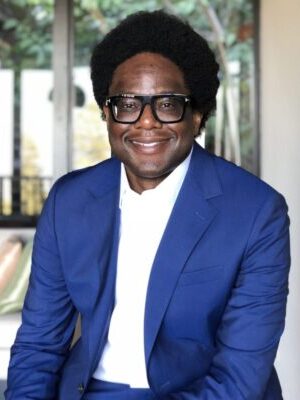
Professor Osagie K. Obasogie’s ‘Legacies of Eugenics’ Project
By Gwyneth Shaw,
Berkeley Law
| 08. 23. 2024
In this episode, host Gwyneth Shaw talks to Professor Osagie K. Obasogie, a professor of law and bioethics and the only UC Berkeley faculty member to hold an appointment at both our law school and our School of Public Health(opens in a new tab), including the Joint Medical Program(opens in a new tab) with UC San Francisco. As a sociologist of law and medicine, Obasogie’s research combines doctrinal scholarship with empirical methods and novel theoretical approaches to understand the ways race is central to how the institutions of law and medicine operate.
He’s the author of Blinded By Sight: Seeing Race Through the Eyes of the Blind and co-editor of Beyond Bioethics: Toward a New Biopolitics, and his scholarship has been published in top law reviews as well as major medical and science journals. Obasogie is an elected member of the National Academy of Medicine and won a Guggenheim Fellowship in 2022.
Recently, he organized and wrote the opening essay for a major project published in the Los Angeles Review of Books, “Legacies of Eugenics...
Related Articles
By Gaia Ghirardi, Arno Van Hootegem & K. Paige Harden , Nature Human Behaviour | 09.21.2026
Embryo screening for behavioural traits is no longer speculative. If you want to become a parent in the USA today, you can pay to use pre-implantation polygenic testing (PGT-P) of in vitro fertilization (IVF)-created embryos. PGT-P promises to optimize offspring...
What We Inherit by Sam Trejo and Daphne O. Martschenko; and Original Sin by Kathryn Paige Harden have a great deal in common, with substantial differences in style and emphasis. Both books attempt, in different ways, to show the reader just where current research into human genomics stands, where that might be going, and why the authors are interested. In short, the influence of genomic research on our societies is already large and seems likely to change them in ways...
By Dan Falk, Nautilus | 08.20.2026
The pseudoscience of eugenics, founded on the mistaken notion that nature envisions some “right” combination of genes, and that selective breeding can improve the human race, is making a comeback. While the heyday of eugenics was a century ago, the...
By Adithi Ramakrishnan, AP News | 08.05.2026
NEW YORK (AP) — Matt Walker couldn’t pet a dog without sneezing — until he and other scientists used a gene editing technique to produce a hypoallergenic beagle named Bailey.
Now, he can feed Bailey spoons of peanut butter while...