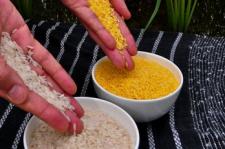
Expert: Blaming Greenpeace for blocking Golden Rice is “sleazy sleight of hand”
By Claire Robinson and Jonathan Matthews,
GMWatch
| 06. 02. 2024
With the recent Philippines court decision blocking the further planting of GM Golden Rice in the country, pro-GMO advocates have renewed their attacks on Greenpeace, which, with the farmer-scientist network MASIPAG and others, brought the lawsuit.
The Observer’s science editor Robin McKie has published an article accusing Greenpeace of causing “a catastrophe” by its role in the court case. GM Golden Rice is engineered to contain the vitamin A precursor beta-carotene and is targeted at poor people, especially children, suffering from vitamin A deficiency (VAD).
The Observer also chimed in with an editorial headlined, “When modified rice could save thousands of lives, it is wrong to oppose it”, and subtitled, “The green movement’s attempts to block the cultivation of a grain enhanced with vitamin A is misguided”.
However, experts on Golden Rice have roundly debunked the claims, with one pointing out that blaming Greenpeace for blocking the GM crop is “a sleazy sleight of hand to hide the fact that after 30 years of development, Golden Rice is still not ready”. Glenn Davis Stone, Research Professor of Environmental Science at Sweet...
Related Articles
By Ann E. Marimow and J. David Goodman, The New York Times | 09.22.2026
Justice Elena Kagan on Tuesday refused to intervene in a high-profile custody battle that involved difficult questions surrounding surrogacy and abortion, leaving in place a lower-court order that gave custody to the biological parents in the dispute.
The case drew...
By Anna Collinson and Jo Adnitt, BBC | 08.18.2026
At least 30 children, most of them British, are feared to have been conceived by IVF treatment in northern Cyprus using the wrong sperm or egg donors.
In each case, the parents suspect they did not get the donors they...
By Hamed Aleaziz, The New York Times | 08.13.2026
Immigrants at Ellis Island undergoing a medical inspection | Photo by The New York Public Library on Unsplash
In 1924, Congress sent a message to the world: We are no longer ready to take “your tired, your poor, your huddled...
By Editors, Nature | 08.18.2026
Shinya Yamanaka doesn’t see himself as a celebrity. But people do recognize the stem-cell researcher when he’s out for a run, often while training for a marathon, on the streets of Kyoto, Japan.
Many of them call out words of...