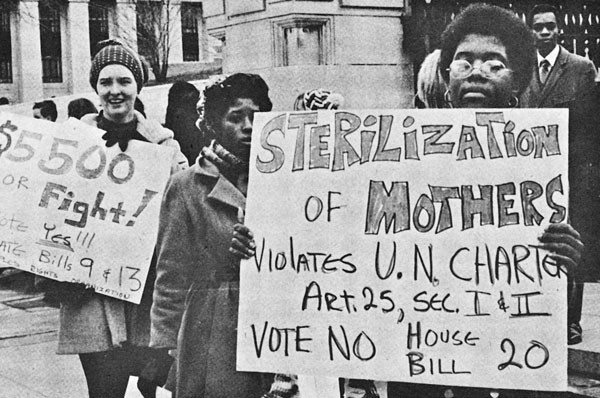
Eugenics today: where eugenic sterilisation continues now
By Robert A Wilson,
Aeon
| 06. 05. 2018
Eugenics was a mixture of science and social movement that aimed to improve the human race over generations. Those of good stock were to produce more children, and those of bad stock were to produce fewer (or no) children. The English polymath Francis Galton coined the term ‘eugenics’ in his Inquiries into Human Faculty and its Development (1883), and by the early 20th century the eugenics movement was gaining steam on both sides of the North Atlantic.
Both in popular culture and in academia, eugenics is thought of as long-past, going extinct shortly after 1945 due to the extreme forms it took in fascist Germany. The Nazi enthusiasm for eugenics led to concentration camps, involuntary euthanasia, and genocide. Once the rest of the world recognised this, eugenics was done – not simply as a social movement with state support, but as an endorsable idea guiding social policy.
But this view doesn’t capture what eugenics feels like from where I have stood for the past 20 years.
For most of the past two decades, I have lived in the Canadian province...
Related Articles
Artificial Intelligence (AI) has been a major focus of news recently, as it should have been, under the appropriately ridiculous name of Hugging Face, “a leading collaboration platform and community hub for machine learning, artificial intelligence, and data science.” In July, Hugging Face was hacked. The platform itself responded:
Earlier this week, we detected and responded to an intrusion into part of our production infrastructure. This one was different from anything we had handled before in one important way...
By Gay Pasley, Essence | 09.04.2026
That is what makes the unfolding case of McKenna West so important. It is more than a disagreement about abortion or a dispute over a surrogacy contract. It asks whether an agreement signed before a pregnancy can become authority...
By Anna L. Philippe, Pop Panic | 09.17.2026
What does it mean when education is considered a threat to population? As an education student, I am interested in the ways population panics are essentialized and circulated in formal education settings. Schools can play a major role in shaping...
By Ava Kofman, The New Yorker | 09.15.2026
A WOMAN WHO ACTS AS A SURROGATE, carrying a child for someone else, is said to be going on a “journey.”
Kayla Elliott started her surrogacy journey at the age of twenty-six. She gave birth to a baby girl for...