Donald Trump’s Decades-Long Obsession With Eugenics
By Julia Métraux,
Mother Jones
| 05. 28. 2025
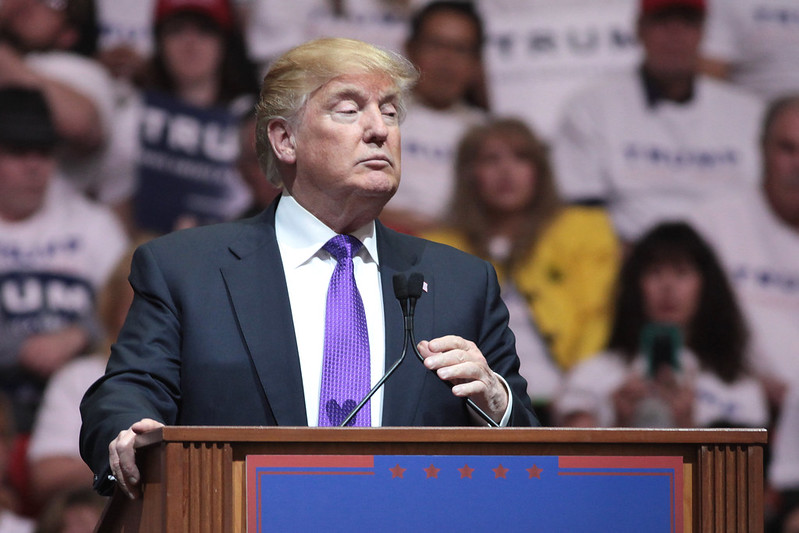
"Donald Trump speaking with supporters at a campaign rally at the South Point Arena in Las Vegas, Nevada" by Gage Skidmore licensed under CC by SA 2.0
Many people were shocked to read allegations last year by Donald Trump’s nephew, Fred Trump III, about his uncle: Fred, whose son William has intellectual and developmental disabilities, reported that the elder Trump said during his first presidential term that people like William should “just die.”
That is shocking—but it’s not surprising. The comment falls into a pattern of eugenicist and ableist views that Trump has espoused all the way back to the 1980s, when he spoke openly about the importance of having “the right genes” in an appearance on The Oprah Winfrey Show.
The opposition’s failure to address and confront Trump’s eugenicist views, the American studies scholar Susan Currell wrote in a 2019 article, “shows that a wide-ranging eugenic ideology is embedded in the broader American body politic.” The lack of emphasis on Trump’s comments and record around disability and genetics bears that out. Trump makes...
Related Articles
By Ann E. Marimow and J. David Goodman, The New York Times | 09.22.2026
Justice Elena Kagan on Tuesday refused to intervene in a high-profile custody battle that involved difficult questions surrounding surrogacy and abortion, leaving in place a lower-court order that gave custody to the biological parents in the dispute.
The case drew...
By Anna Collinson and Jo Adnitt, BBC | 08.18.2026
At least 30 children, most of them British, are feared to have been conceived by IVF treatment in northern Cyprus using the wrong sperm or egg donors.
In each case, the parents suspect they did not get the donors they...
By Hamed Aleaziz, The New York Times | 08.13.2026
Immigrants at Ellis Island undergoing a medical inspection | Photo by The New York Public Library on Unsplash
In 1924, Congress sent a message to the world: We are no longer ready to take “your tired, your poor, your huddled...
By Editors, Nature | 08.18.2026
Shinya Yamanaka doesn’t see himself as a celebrity. But people do recognize the stem-cell researcher when he’s out for a run, often while training for a marathon, on the streets of Kyoto, Japan.
Many of them call out words of...