
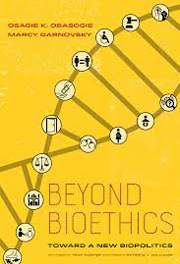
Beyond Bioethics: Toward a New Biopolitics
By Daniel Bojar,
The Biologist [review of the book edited by CGS' Osagie K Obasogie and Marcy Darnovsky]
| 09. 06. 2018
The dramatic pace of scientific discoveries in recent decades has not only led to remarkable improvements in domains such as healthcare or forensics, but has also posed new questions and challenges to society. How do we deal with privacy in an age of commercialised genome sequencing? How do we decide to incorporate concepts of race, gender and class into our restructured healthcare system? These thorny issues and many more are tackled in Beyond Bioethics.
The book itself is a collection of dozens of essays by bioethicists, activists and thinkers from a range of disciplines, collected and curated by Osagie Obasogie and Marcy Darnovsky. Grouping these essays into thematic categories, the imposing bioethical problems of our age are investigated one by one. While the negative outlook provided by many essayists may sometimes seem overwhelming, the diversity of opinions and approaches does justice to the importance of topics such as surrogate pregnancies, negligence of underserved segments of the population, or the finicky subject of who is testing the drugs of the future in clinical trials.
In fact, as the editors of the...
Related Articles
By Carly Mallenbaum and Alex Golden, Axios | 04.08.2026
Without a federal law, surrogacy in the U.S. is governed by a patchwork of state regulations that can determine everything from whether agreements are legally binding to who is recognized as a parent at birth.
Why it matters: More Americans...
By Miguel Muñoz, Cadena SER | 08.04.2026
"Para ellos, una familia numerosa no solo es una preferencia personal, sino que es una obligación. Creen que tener tantos hijos como sea posible es necesario para evitar un futuro apocalíptico", aseguraba Xavier Orri, periodista y cofundador de Página Internacional...
By Mary Hartnett, WFYI | 03.30.2026
"1907 Indiana Eugenics Law" via Wikimedia Commons | CC by-SA 4.0
Indiana was the first government in the world to pass a eugenic sterilization law. The state sterilized 2,500 people from 1907-to-1974. Indiana apologized for implementing the program...
By Sarah Elizabeth Richards, Scientific American | 04.02.2026
For the past two decades, fertility specialists have wrestled with a troubling question: Why do Black people have lower live birth rates after in vitro fertilization (IVF) treatment than white people?
Researchers have proposed several explanations, such as the fact...