Human-Animal Chimeras and Dehumanization
By John H. Evans,
Oxford University Press Blog
| 10. 01. 2016
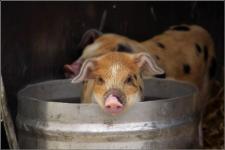
The US government recently announced that it was lifting its moratorium on funding certain experiments that use human stem cells to create animals that are partly human. At present scientists are only interested in creating entities with some human qualities, but which remain “mostly” animals. For example, some scientists want to create a chimeric pig with a human-enough heart to transplant into a human.
Distinguishing between humans and other animals is common in most cultures and is certainly central to Western intellectual and religious traditions, so the idea of a part-pig part-human is very unsettling to many people. Warnings about the dangers of mixing animals and humans are also a classic theme in Western culture with novels like the Island of Doctor Moreau by H.G. Wells.
We can all agree that the world is not ready for a talking pig, and there is clearly a dystopian novel waiting to written about the pig given human consciousness but without the ability to interact. Moreover, an entity with a human body but a pig brain, which would be useful for human transplants...
Related Articles
By Charles Schmidt, Undark | 09.25.2026
In 2010, scientists at the University of Tokyo and other institutions reported a startling achievement: They had successfully grown a pancreas made almost entirely of rat cells within the bodies of mice. The research was directed by Hiromitsu Nakauchi, a...
By Karen Weintraub, Endpoints News | 09.16.2026
To better understand certain neuropsychiatric disorders, researchers at Stanford University have bred rodents that lack a cortex and hippocampus and then replaced those missing brain cells with human ones.
The altered mice, a scientific first, provided insights that would not...
By Emily Anthes, The New York Times | 08.31.2026
For thousands of years, we have been trying to craft our ideal canine companions. We have honed their abilities to perform an array of specific tasks, from fetching waterfowl to staring down wayward sheep. We have reshaped and refined their...
By Adithi Ramakrishnan, AP News | 08.05.2026
NEW YORK (AP) — Matt Walker couldn’t pet a dog without sneezing — until he and other scientists used a gene editing technique to produce a hypoallergenic beagle named Bailey.
Now, he can feed Bailey spoons of peanut butter while...